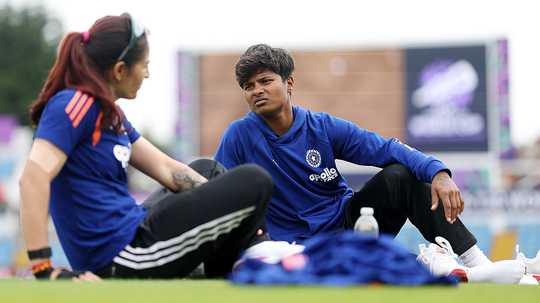
India winning games through their batters and spinners is hardly a plot twist. In the post-Jhulan Goswami era, asking the seamers to steal the show usually is rare. Renuka Thakur has had her memorable days, so has Arundhati Reddy. Nandni Sharma made an immediate impact in international cricket. But these standout performances have rarely come in starring roles.
The ongoing World Cup hasn't spun a different tale either. But what stands out is that - of the 12 teams participating in the tournament, India have been least reliant on their seamers.
It's not just about how frugally the pacers have been used, but also their larger ineffectiveness in this competition. The wickets are not coming, the runs are leaking, and the ball is moving around lesser for them as compared to their counterparts - least swing and fourth-least seam movement (Yes, Renuka Thakur not featuring in the XI could have played a part).
But all in all, there is one major weakness that India is carrying and the solutions remain uncertain. In the ongoing World Cup, the Indian pacers have picked the least number of wickets, have the poorest strike rate and average, and been the third most expensive pace attack in the competition (after Netherlands and Pakistan).
@B0$
It's not that the Indian pacers have been unlucky. Apart from Babette de Leede getting dropped off the bowling of Kranti Gaud, all off India's dropped catches have come when spinners were in operation. Moreover, the Indian seamers have induced the least percentage of false strokes among all the pace attacks in the competition.
It's not even the case of playing on tracks that are unfriendly for seamers. In fact, Bangladesh have featured in two of three venues India played in, returning with much better figures. And so has been the case for Netherlands.
While India have relied on their spinners - with Shafali Verma offering handy company to the frontliners to ensure that they remain the most potent spin attack, this poor form of the pacers has been a long-standing issue.
* * * * *
Since the last T20 World Cup in 2024, Indian pacers have had the worst average, second poorest strike rate and been the third most expensive pace attack among all the teams involved in the competition (only includes players playing in the 2026 World Cup). These parameters come up with similar readings even if performances in T20 leagues and domestic games are to be factored in.
None of this should really come as a surprise, since India were the second-worst performing pace attack - in terms of average and strike-rate - even during the victorious 2025 50-over World Cup campaign. In the final, eight wickets fell to spinners, with the other two being run-outs.
Mid-way through the group stage of the World Cup, the Indian team management still remains uncertain on its two best pace options - having tried three different combinations in as many games.
The injury to Shreyanka Patil has left the team management now with a massive void to fill in the death overs - for which there aren't too many options. Even in this year's WPL, Renuka Thakur had bowled only one over in the death and Kranti Gaud had bowled none. Thus, even the inclusion of the uncapped Nandni Sharma wasn't as outlandish as it was wise.
Nandni brings in a vast range of skills - has a sharp bouncer (a massive rarity), can swing the ball both ways, deploys several variations of the slower ball, can reverse the ball, and is one of the few operators who can bowl across all phases of play. Most importantly, she thrives in the death under pressure - a skill that wasn't quite trusted with in the game against South Africa. And when Deepti Sharma had an off day, the weaknesses of the attack came exposed.
But, as yet, only one ball of pace has been employed in the death by India. The bigger concern with the seamers is their inability to take wickets upfront and create the early pressure
While seamers who have bowled the conventional good length areas in the powerplay have found more success in this tournament, Indian seamers have chosen to take another route. One key aspect of their powerplay bowling has been the excess use of hard length deliveries - nearly 55 percent of the balls have been banged on hard lengths - which haven't offered the desired results. With not much movement to support that, not surprisingly, Indian seamers have induced the least false shots in this phase of play.
Moreover, on average, Indian pacers have operated at a slower pace compared to other teams (except Scotland and Ireland). Many of the fuller length deliveries that they have used, have come as a slower one.
This World Cup is playing a similar script that it so often has: the spinners are carrying the attack, and the batters are providing the muscle - even if they are not doing it fully, they would need to get on board quickly for India's chances. With the seamers, the dependency may not be high, but as the tournament heads to the critical half, the team management would look not want to leave any ends loose.
Stats by @L0$